
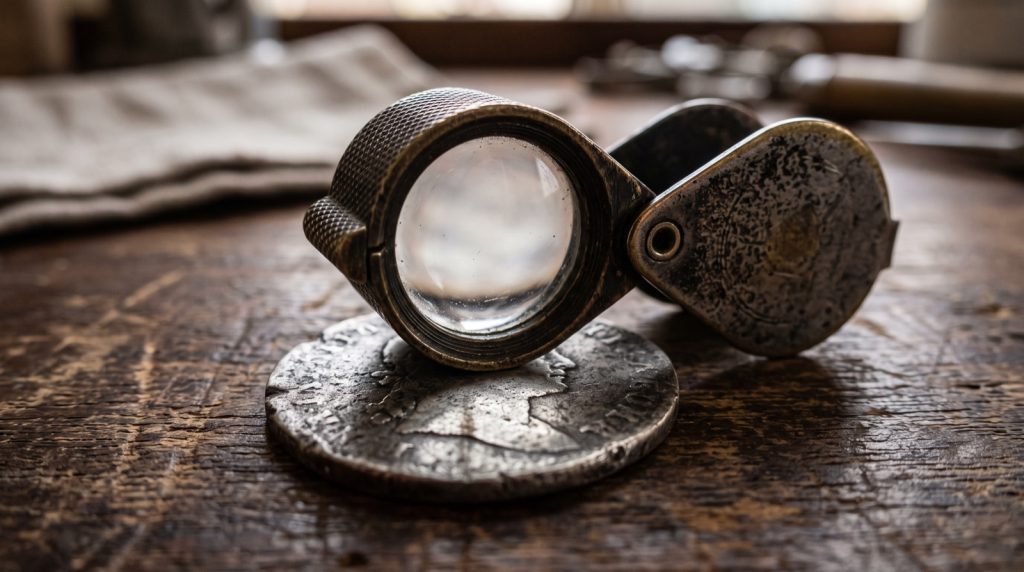
As gold and silver have drawn more attention, so have counterfeits. Some are crude enough to fool no one; others are good enough to slip past a casual glance. When experienced buyers pick up an unfamiliar coin, they tend to run through the same short list of checks, roughly in the same order. Here are the tells they check first.
1. The look: start with a loupe
A 5x to 10x magnifier reveals most bad fakes. Experts look for:
- Soft or blurry details in hair, feathers, and lettering, especially the date and mint mark.
- Tiny pits, bubbles, or seams that suggest a cast coin rather than a struck one.
- Wrong color. Gold-plated fakes can look too yellow or show a different metal at worn spots or the edge.
- Odd luster. Genuine mint luster has a soft cartwheel effect when you tilt the coin; many fakes look flat or glassy.
2. Weight against the specification
Every genuine coin was struck to an exact weight, and that number is published. A one-ounce American Silver Eagle should weigh about 31.1 grams; a one-ounce South African Krugerrand weighs about 33.93 grams because it contains copper alloy alongside its full ounce of gold. Use a scale that reads to at least a tenth of a gram. Underweight or overweight coins deserve suspicion.
3. Diameter and thickness
Weight alone can be matched by a clever counterfeiter, but matching weight, diameter, and thickness at the same time with a cheaper metal is very hard. A pair of digital calipers lets you check all three against the official specs.
4. The magnet and the slide
Gold and silver aren’t attracted to magnets. If a strong magnet grabs your coin, it isn’t solid gold or silver. With a silver bar or large silver coin, try angling it and letting a magnet slide down the face: on genuine silver, the magnet slows noticeably as it descends. Not every fake is magnetic, so passing this test proves less than failing it.
5. Specific gravity
Every metal has a characteristic density. Pure gold’s specific gravity is about 19.3; pure silver’s is about 10.5. Coin alloys come in somewhat lower, but within a predictable range. A specific gravity test — weighing a coin in air and then in water — can expose a base-metal core. Tungsten is the notable exception, because its density is close to gold’s.
6. The ring
Precious metals ring when gently tapped. A genuine silver coin produces a long, bright tone; many fakes sound dull and die out quickly. The test works best side by side with a coin you know is real.
Where simple tests fall short
Well-made fakes may pass several home tests. For valuable pieces, dealers commonly rely on X-ray fluorescence analyzers, ultrasonic testing, or third-party authentication by PCGS or NGC. Counterfeit grading holders exist too, so verify any certification number on the grading service’s own website.
A second opinion is free
If something doesn’t feel right about a coin, bring it to All Valley Coin & Jewelry at 28480 Old Town Front St, Suite C, in Old Town Temecula. Verbal appraisals are always free. We’re open Monday through Friday 10am–5pm and Saturday 9:30am–5pm, or call (951) 757-0334.