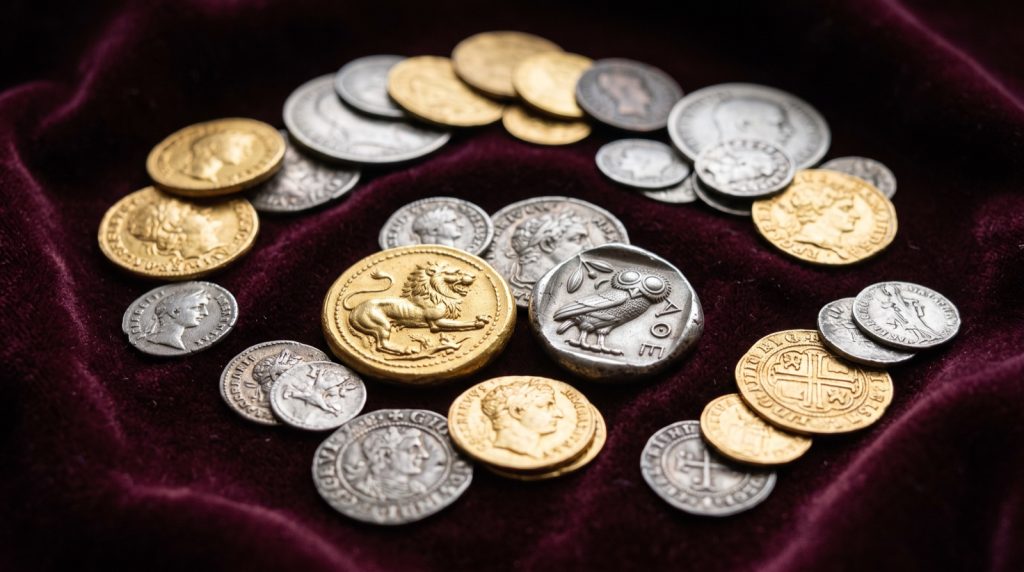
Maybe it’s a coffee can of old change from a grandparent, or a few gold pieces tucked in a drawer for decades. Before you sell anything, it pays to understand what actually drives a coin’s value. You don’t need to become an expert overnight — you just need to know which questions to ask. Here’s a practical way to think it through.
Step 1: Sort the metal from the collectibles
Start by splitting your coins into two rough piles. The first is coins whose value comes mostly from precious metal: modern bullion coins, bars, rounds, and pre-1965 U.S. dimes, quarters, and halves, which are 90% silver and often called “junk silver” in the trade. The second pile is anything older, unusual, or in especially nice condition — those may be worth more than their metal.
Step 2: Learn the spot price
Spot price is the current market price for one troy ounce of gold, silver, platinum, or palladium, and it changes throughout the day. Bullion is priced from spot. To estimate a coin’s metal value, multiply its fine metal content by spot. A pre-1965 silver quarter, for example, holds a little under two-tenths of a troy ounce of pure silver. Any reputable buyer should be able to show you how their offer relates to spot.
Step 3: Look for rarity
Rarity is about how many coins were made and how many survive. Check the date and the small mint mark letter — D for Denver, S for San Francisco, O for New Orleans, CC for Carson City, or no mark for most Philadelphia coins. Certain combinations are famously scarce. The 1916-D Mercury dime and the 1937-D “three-legged” Buffalo nickel are good examples of coins where one date and mint changes everything. A quick search of a reputable price guide will tell you whether your date is a key date or a common one.
Step 4: Be honest about grade
Grade is a coin’s condition, scored on a 1-to-70 scale. A coin that barely circulated can be worth several times as much as the same date worn smooth. Look at the highest points of the design — the hair, the cheek, the eagle’s feathers — for flattening. For valuable coins, grading by PCGS or NGC can confirm the grade and make the coin easier to sell.
What not to do before you sell
- Don’t clean your coins. Polishing, dipping, or scrubbing removes original surfaces and can cut a collectible’s value dramatically.
- Don’t break up sets or rolls until someone has looked at them as a group.
- Don’t remove coins from certified holders. The holder is part of the value.
- Don’t rely on a single online listing. Asking prices aren’t selling prices.
Putting it together
Once you know a coin’s metal value, its rarity, and its approximate grade, you’ll have a realistic range in mind — and you’ll be able to tell a fair offer from a lowball one.
Let us take a look
If you’d rather not do the homework alone, bring your coins to All Valley Coin & Jewelry at 28480 Old Town Front St, Suite C, in Old Town Temecula. Verbal appraisals are always free, with no obligation to sell. We’re open Monday through Friday 10am–5pm and Saturday 9:30am–5pm. Walk in, or call (951) 757-0334 to book a time.