Spend five minutes around coin collectors and you’ll hear it: “That one’s a sixty-five.” “It’s AU, not Mint State.” “Nice VF, but cleaned.” Grading shorthand can sound like a secret language, but it’s really just a way to describe condition precisely — and condition is one of the biggest drivers of what a coin is worth. Let’s decode it.
The 70-point scale in a nutshell
Almost every U.S. coin today is graded on the Sheldon scale, which runs from 1 to 70. The letters tell you the general condition; the number pinpoints it. A 1 is a coin you can barely identify. A 70 is a coin with no visible flaws even under magnification. Everything else falls in between.
The three abbreviations you’ll see most
MS — Mint State (60 to 70)
Mint State means the coin has never been spent or carried. There is no wear at all. The grade within that range depends on how many contact marks it picked up at the mint, how strong the strike is, how much luster it has, and how attractive it looks overall. An MS-60 may be noticeably marked up; an MS-67 is a superb coin that stops collectors in their tracks.
AU — About Uncirculated (50 to 58)
An AU coin saw just a little time in circulation — a pocket, a cash drawer, a coin album that got handled. You’ll find only slight rubbing on the very highest points, and much of the original shine is still there. At a glance, many AU coins look uncirculated, which is why this grade catches people off guard.
VF — Very Fine (20 to 35)
A VF coin has clearly been used, with moderate wear on the high points, but the important details are still sharp and easy to read. For many older and scarcer coins, a solid VF is where collectors find the best balance of eye appeal and affordability.
Where the other grades fit
- XF or EF (40–45), Extremely Fine: Light wear, with nearly all fine detail intact.
- F (12–15), Fine: Plenty of wear, spread evenly, yet the main design still stands out clearly.
- VG (8–10) and G (4–6): Heavily worn, with the design outlined but flat.
- AG, FR, and P (3, 2, 1): Worn nearly smooth.
- PR or PF: Proof, a special striking method rather than a condition, graded on the same 70-point scale.
Why one point can matter so much
Near the top of the scale, small differences carry big price gaps. For a popular series like Morgan silver dollars, the difference between MS-64 and MS-65 can be dramatic, because far fewer coins survive at the higher grade and many collectors want only the best. Further down the scale, the gaps tend to be smaller.
Raw coins vs. certified coins
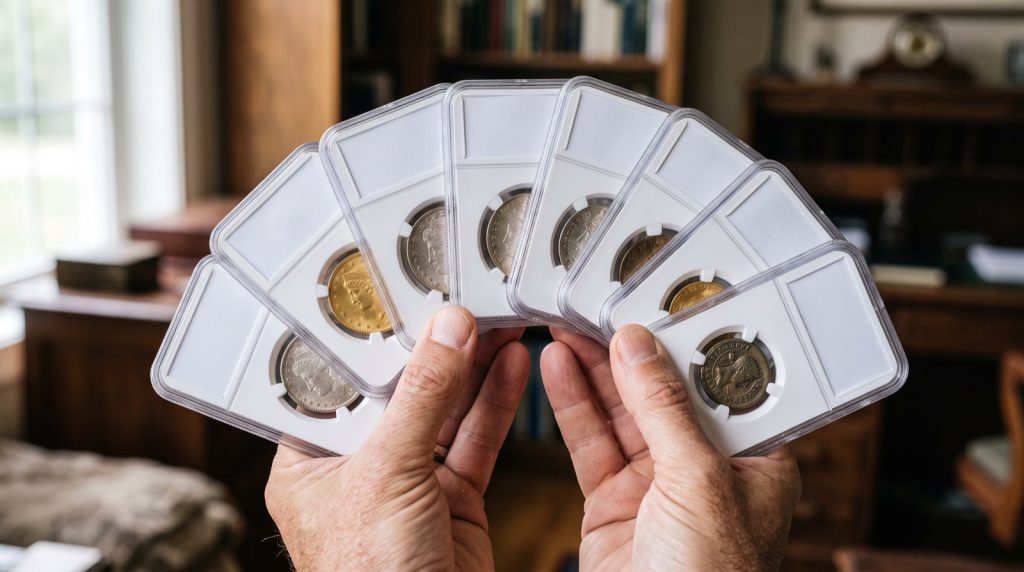
A “raw” coin is one that hasn’t been professionally graded. A certified coin has been examined by a third-party service such as PCGS or NGC and sealed in a protective holder with its grade on the label. Certification takes the guesswork out of a sale, and it flags problems like cleaning or damage with a “details” designation.
See your coins through an expert’s eyes
At All Valley Coin & Jewelry, collectible coins are graded against PCGS and NGC standards — and we’ll explain what we see as we go. Visit us at 28480 Old Town Front St, Suite C, Temecula, CA 92590, Monday through Friday 10am–5pm or Saturday 9:30am–5pm, or call (951) 757-0334.